

By now most people who are online know that some of Microsoft’s services broke down from Thursday evening and well into Friday. In at least 74 countries, people lost the ability to send and receive email: as private individuals, as officials in public administrations and NGOs, and as employees of companies large and small (Euronews).
It wasn’t only email, though. Teams, OneDrive, SharePoint, calendars and Microsoft’s security tools went with it. And it clearly showed the dependence on one provider that runs through our digitised and tightly integrated societies.
The outage turned into an unscheduled test of resilience, response and practical digital sovereignty. Not the version you find in committee reports, political statements and panel debates, but the one that plays out in homes, businesses and administrations across Europe.
The services are more or less back now. Microsoft’s status page read “All products are operational” on Saturday evening. We won’t go into how or why it happened (Microsoft has blamed a problem from an earlier network capacity upgrade that surfaced after a recent network change, according to franceinfo). This piece looks at the characteristics of the event, and at what happened to the people it hit.
If this had been deliberate
Keep one thing in mind while reading. This was an accident, and it was over in about a day. The central premise of the European sovereignty debate is a different scenario: a foreign government deliberately removing a service from people in the EU. That outage would not be gone in 24 hours. Email would still be down today, tomorrow, maybe even for the foreseeable future, and people still could not reach each other, their public sector administrations, or the businesses they deal with, and the other way around. The exception would be the few who have already moved to more sovereign and resilient solutions. You’ll find some of them mentioned here.
The lowly email
Email has come a long way. It started as a simple tool at the dawn of the internet and is now the backbone of digital communication, to a degree we hardly notice. We take it for granted every day, for serious communication and mundane tasks.
A long web address, dictated character by character
Marion helps residents of five social centres with their online paperwork. On Friday an elderly resident asked her to email a link to the government site where she could check her benefits. Marion couldn’t, so she read the address out to her, one character at a time.
Source: franceinfo
That is what it looks like when the inbox goes.
Town halls without a front door
Reports of children at risk, documents possibly lost
Email is one of the channels for reporting a child at risk. On Friday the city’s youth welfare office could not be sure such reports had arrived, and asked anyone who had sent one to call it in again.
Source: bielefeld.de
This could look like small problems, but the pattern repeated all across the continent. In the Netherlands, some 20 municipalities and five provinces were hard to reach (Hart van Nederland). In Krimpen aan den IJssel residents could still use the municipal website to send applications for products and services, but got no confirmation email (NOS). In Sweden every municipality in Blekinge was hit, along with Göteborg, the Västra Götaland region and some 20 more municipalities from Halmstad to Karlskoga (SVT). Helsinki reported email and Teams trouble for practically all staff (Yle). In Denmark, the municipalities, such as Fredensborg’s roughly 2.700 employees could neither send nor receive email (Frederiksborg Amts Avis). The city of León in Spain moved its official communications to Gmail accounts for the day (La Nueva Crónica). And the list goes on.
Justice on hold
Dutch courts could send and receive email only in part (Hart van Nederland). Estonia’s Harju County Court could not send procedural documents and asked parties to use the state e-file service (ERR). In Ireland the Courts Service, the Law Library and the Legal Aid Board lost emails (Irish Legal News). Italy’s Constitutional Court set up a WhatsApp group to get its press releases out, and in Bolzano the outage reached PEC, the certified email that carries legal weight in Italy (Il Fatto Quotidiano).
Governments on chat apps
Several Portuguese ministers lost email access and, according to SIC Notícias, moved to WhatsApp and Signal (Euronews). The Czech finance ministry’s email stopped working (ČT24). Italian ministries from the interior to education reported disruption (Il Fatto Quotidiano), and Greece’s digital governance minister confirmed that public-sector email was hit (Newsbomb). Moving the business of government to consumer chat apps was sometimes chosen a workaround, and it raises its own questions about records and security.
Clinics, classrooms and fire brigades
Ireland’s national clinical email, Healthmail, went down, and the health service agreed paper-based workarounds so that prescriptions still reached pharmacies (TheJournal.ie). Six Dutch hospitals reported email problems (NH Nieuws). In Hauts-de-Seine, a psychiatric nurse whose team visits patients in 11 communes could not confirm next week’s appointments, because they all live in Outlook calendars. In Paris a history teacher lost access to every lesson she keeps on OneDrive and went back to her old textbooks (franceinfo). In Upper Austria, all email traffic of the fire brigades’ federation was affected (austria.com).
Business at a standstill
“It’s forced downtime”
Sébastien runs a small training company. The login codes for the state’s training platform arrive by Outlook email, so on Friday he could register no one. He has three days to declare a session on the platform or he is not paid, and each session is worth between €1.500 and €4.000.
Source: franceinfo
Further up the scale, Euronext (the pan-European stock exchange and market infrastructure) asked listed companies to phone because its listing teams could not receive email, and Richemont published its half-year results late (Orange/AFP). Poland’s mBank asked clients to phone or chat (Focus Europe). Deutsche Bahn had delays because short-notice timetable changes could not be emailed (Handelsblatt).
These are just a few examples of the resulting friction and problems resulting from the outage.
The damage report
No European organisation has published a loss figure as a consequence of the breakdown so far. The only number currently in circulation is a Morningstar DBRS estimate of USD 300 to 500 million in insured losses worldwide, reported by RTÉ. Germany’s federal cyber security agency, the BSI, expects “a very large impact on the German economy” (Tagesschau). Microsoft has not mentioned compensation.
What the cases do show is the shape of the loss: reports that had to be filed again, court papers not served, prescriptions rerouted, ministers on consumer apps, orders on hold and a day of staff time spent on workarounds.
The loss also reached people who never opened Outlook themselves, through the messages that did not arrive. Slovakia’s state railway warned that e-tickets bought online could reach buyers late (Zem a Vek). Patients of Utrecht’s St. Antonius hospital were told they might not get alerts about new test results and should check the patient portal (Hart van Nederland). In Ireland some emails to patients did not arrive (TheJournal.ie), and welfare queries to the Department of Social Protection were delayed, though payments went out (Irish Examiner). There were reports on social media of missing plane tickets and other vital emailed information.
How people worked around it
The telephone came back as a tool first. Fredensborg told citizens with urgent matters to call (Frederiksborg Amts Avis), British police forces asked people to ring 101 instead of using web forms (ITV), and Euronext and mBank sent customers to the phone. Some British GP surgeries asked patients to stop sending messages through their websites, and at Westminster, where MPs lost access through their parliamentary accounts, business carried on under “alternative communication arrangements” (BBC).
Next came the consumer apps. Besides the Portuguese ministers and the Italian court mentioned above, firms in Saxony-Anhalt’s Salzlandkreis switched to phone and WhatsApp (Volksstimme). Social media became the notice board: Kraków warned residents on X (Super Biznes) and Furesø’s mayor explained the situation on Facebook (Alt om Furesø). Ironically, Microsoft itself relied on X while its own service status page was briefly down (TechRadar).
And then paper. Irish GPs and pharmacists were told to use paper prescriptions (RTÉ), some Norwegian MPs went back to pen and paper (Aftenposten), and the Paris teacher taught from her old textbooks. Estonia’s court had a sovereign fallback ready: the state’s own e-file system. We found no report (yet) of anyone reaching for the fax machine, not even in Germany, where many medical practices and public offices still keep one.
Each workaround kept something moving, and each moved official business onto channels with weaker records, weaker security or, in some cases, no audit trail at all.
Who kept working, and why
Schleswig-Holstein barely noticed. The German state decided in 2020 to move its administration to open source, and in 2025 moved about 40.000 mailboxes off Exchange and Outlook (Politico Europe). “We didn’t notice a thing”, Sybilla Lena Nitsch, a member of the state parliament for the Danish regional minority party SSW, told the national Danish broadcaster DR. The German state’s digital minister, Dirk Schrödter, put the principle in one line: “We must be able to intervene ourselves at any time if problems arise.”
Magdeburg’s city administration reported no problems, “because we don’t use any Microsoft services” (Volksstimme). Germany’s federal administration runs its Microsoft software on its own infrastructure (IT-Journal) and stayed essentially unaffected. German authorities were not hit because they did not rely on Microsoft 365 services, the head of the BSI, Claudia Plattner, told Reuters (BBC). Poland’s government offices kept working on the state’s own document system (Super Biznes). In hospitals from Utrecht to Ostrobothnia, patient care continued because the clinical systems come from other vendors.
Denmark offers a smaller example. Official letters from public authorities go through Digital Post, the state’s own system, and no disruption to it was reported during the outage. There is a catch, though: Digital Post tells people about new letters by app notifications or email. The letters stayed safe in the mailbox, but anyone whose inbox ran on Outlook would not have known they were there. The weak point was at the town hall end: Ringsted said it could not receive enquiries sent by email, Digital Post or web forms (TV2 Øst), which points to the municipality’s own Microsoft set-up rather than the national system.
Ireland’s health service shows the limit of the usual answer to digital sovereignty. Its data is held in Irish and EU data centres, but Healthmail went down all the same (Trending Topics). Keeping data on European soil is the standard reply to sovereignty concerns. It decides which country’s law applies to the data, but it does not keep a service running when the company that operates it has a fault (or if they are ordered by their own government to shut it down): the HSE’s mail ran on the same Microsoft service that failed everywhere else.Where the data is stored did not decide who kept working on Friday. Who operates the service did. Schleswig-Holstein, Magdeburg and Germany’s federal administration kept working because they run their own systems, with their own people able to step in when something breaks.
But the alternatives come with costs of their own. Sybilla Lena Nitsch says the switch has been hard on data storage and cloud collaboration, especially in justice and policing. Carsten Schürmann, professor at the IT University of Copenhagen, told DR that Microsoft’s integrated system “just works”, and that with free open-source software nobody is responsible for fixing the bugs (see our earlier piece "Will open source save us all?"). Both points deserve a fair hearing. Neither changes the result on Friday.
What the test showed
So what did we learn? Seven things stand out.
- It wasn’t email that failed. It was Outlook. SMTP, the protocol email runs on, kept working, and so did the internet. What broke was the model in which one supplier runs the mail for a large part of a continent. That makes this a question of sovereignty, about who runs email. Ireland’s health service showed that keeping the data in Europe doesn't settle that.
- Email is infrastructure. It carries login codes, court documents, child-protection reports and the notices about changes, deadlines and things to do that people cannot get anywhere else. Even systems that do not depend on Outlook, like Digital Post or the French training platform, failed at the point where they hand over to an Outlook inbox.
- During an outage, email fails in both directions. A sender can only use the address they have on disk. If it ran on Outlook, the message waited in a queue (Microsoft stretched its delivery timeout to 48 hours, TechRadar) and nobody on either side found out about it.
- There is no register to fall back on. You can only email someone who has given you their address. If they never left a phone number or a postal address, there is no other way to reach them.
- A fallback only counts if it exists before the outage. Estonia’s courts had the state e-file system, Germany’s federal administration ran its own infrastructure, and Schleswig-Holstein made its switch years ago. Everyone else improvised.
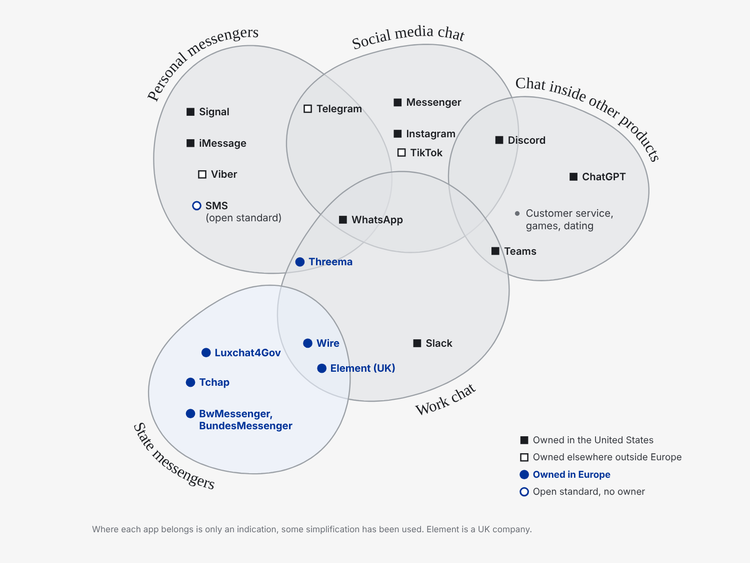
- Today’s fallbacks cannot stand in for email for long. Phones, chat apps and paper lack its speed, its reach and its convenience: one message to many people, attachments, a searchable record. They also move official business onto channels with weaker security and limited audit trail. Over weeks or months, many people would not be on the apps used as stopgaps, and organisations would have to rebuild their contact directories from scratch. We made a similar point about messaging in October, in We are missing a messenger.
- This was not long enough for a real test. A day without Microsoft was survivable with phones, apps and paper. The scenario the sovereignty debate is about would last much longer, and few of the workarounds above would hold.
For about a day, Europe ran the scenario its sovereignty strategies are written for, minus the intent and minus the duration. Town halls lost their front door, courts their post room, and small firms their income. The organisations that controlled their own operations kept working. The political reactions are coming in now, and nupath will return to them next week, when the dust has settled.
Subscribe to our newsletter to get the latest updates and news