


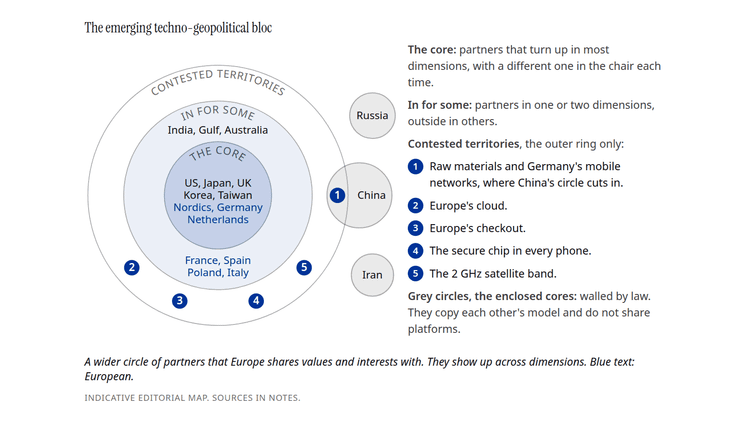
Europe's place in the tech blocs: seven maps, the same territory
In a volatile world, Europe's alliances form one technology at a time. Part one of three.
 By Christian Triantafillou Schade
In a volatile world, Europe's alliances form one technology at a time. Part one of three.
By Christian Triantafillou Schade
Estonia’s e-Residency team and Eesti.ai Council will explore digital identities for AI agents, enabling secure, controlled interactions with digital services. The project, coordinated with public and private partners, aims to define delegated authority for AI agents while reinforcing Estonia’s digital governance leadership. A pilot is planned
(#source_e-Estonia)
Roughly 350 to 400 million smartphones sit in EU pockets today, and only a fraction of them (110 to 134 million) come up for replacement in any given year, and the replacement cycle has stretched past 40 months. Nearly one in five phones already in use is second-hand. Those
By Christian Triantafillou Schade
 By Christian Triantafillou Schade
 By Christian Triantafillou Schade
 By Christian Triantafillou Schade
 By Christian Triantafillou Schade
 By Christian Triantafillou Schade
 By Christian Triantafillou Schade
 By Christian Triantafillou Schade
Massive data centers required for AI expansion face local opposition across Europe over concerns about water and energy use. Operators argue the facilities support digital sovereignty and energy independence. The European Commission introduces a transparency scheme for centres over 500 kW to address sustainability concerns. (DW) Backlash over data centers
(#source_DW)
The Irish Data Protection Commission has fined Google €403 million for unlawful location tracking and ordered compliance with GDPR within six months. The decision follows an eight-year complaint by consumer organisations coordinated by BEUC, which alleged Google manipulated users into allowing constant tracking. (BEUC) Google fined for invasive location
(#source_BEUC)
The European Central Bank introduced Pontes, a platform connecting its payment system to blockchain-based markets, enabling euro-backed transactions. Initial users include Deutsche Bank, Santander and Clearstream. The ECB will also invest part of its €23 billion own funds in blockchain-based securities, Reuters reports. (REUTERS) ECB connects payment
(#source_Cyprus-Mail)
Germany’s openDesk open-source productivity suite has seen high demand, prompting ZenDiS to launch a partner programme. Private sector cloud providers can now build their own offerings based on the suite, supporting digital sovereignty in public administration. (HEISE) Huge demand for openDesk – partner program launches nowZenDiS has launched a
(#source_www.heise.de)
The European Commission proposed a common EU energy rating scheme for data centres with IT power demand above 500 kW, aiming to improve transparency on energy and water use. Labels are expected in 2027, with consultation closing on 14 October. The scheme seeks to support grid stability and waste heat
(#source_www.nupath.eu)
The United States is pushing countries to align with its AI strategy amid concerns that China’s rapid advancements in artificial intelligence could surpass US capabilities. The move reflects growing unease in Washington over Beijing’s progress in the technology sector. (CNN) The US wants the world to pick a
(#source_edition.cnn.com)
Germany’s SPRIND and the Netherlands’ NADI launch a €40M challenge to accelerate European chip design innovation, aiming to reduce dependence on non-EU semiconductor technologies. The initiative targets strategic autonomy in critical tech sectors. (TECH.EU) TEKEVER raises $580M Series D, DTCP closes €455M defence fund, and the challenge
(#source_Tech.eu)
Estonian cybersecurity firm CybExer Technologies will lead a ten-company European consortium developing cybersecurity tests for satellite communications under a contract with the European Space Agency. The project, part of ESA’s Low-LEO activities linked to the EU’s IRIS² secure network, assesses vulnerabilities in the full satellite communications
(#source_e-Estonia)
Axel Voss, a German conservative lawmaker and ally of Commission President Ursula von der Leyen, has criticised the European Commission’s enforcement of the EU AI Act as inadequate. Voss, a member of the CDU, argues the Commission’s response to rapid AI developments is insufficient and highlights gaps in
(#source_Politico)
The EU’s chief AI adviser, Jim Hagemann Snabe, told commissioners on 4 September that the bloc should focus on deploying AI to boost productivity across sectors like health, agriculture and manufacturing. The Commission is mapping AI applications and barriers as part of a strategy due in early 2027, POLITICO
(#source_Politico)
Italy’s Clastix secures €2.9 million in a Seed round led by CDP Venture Capital Sgr, with Mistral and Vertis SGR participating. The Naples-based company develops sovereign Kubernetes infrastructure to reduce operational overhead and support AI-scale workloads, positioning itself as a European alternative to hyperscaler-dependent solutions.
(#source_EU-Startups)
A peer-reviewed paper and interactive maps analyse the email security posture of around 15,300 municipalities in Switzerland, Germany and Austria. The study compares digital sovereignty measures using public DNS records and network signals, classifying providers by jurisdiction and assessing SPF and DMARC configurations. (SECASSURE2026.MXMAP-PROJECT.ORG) Analysis
(#source_secassure2026.mxmap-project.org)
The European Commission proposed a common EU rating scheme for data centres to improve transparency on energy and water use, covering facilities with IT power demand above 500 kW. The scheme aims to support grid stability and waste heat reuse, with labels expected in 2027. Consultation closes on 14 December
(#source_eeNews-Europe)
French chip designer SiPearl has begun delivering its Rhea1 CPUs to Bull for integration into Jupiter, Europe's most powerful supercomputer. The 80-core chip, based on Arm's Neoverse V1 design, will power a CPU-only partition of 1,300 nodes with an estimated 5 petaFLOPS output,
(#source_The-Register)


