Europe's place in the tech blocs: seven maps, the same territory
In a volatile world, Europe's alliances form one technology at a time. Part one of three.


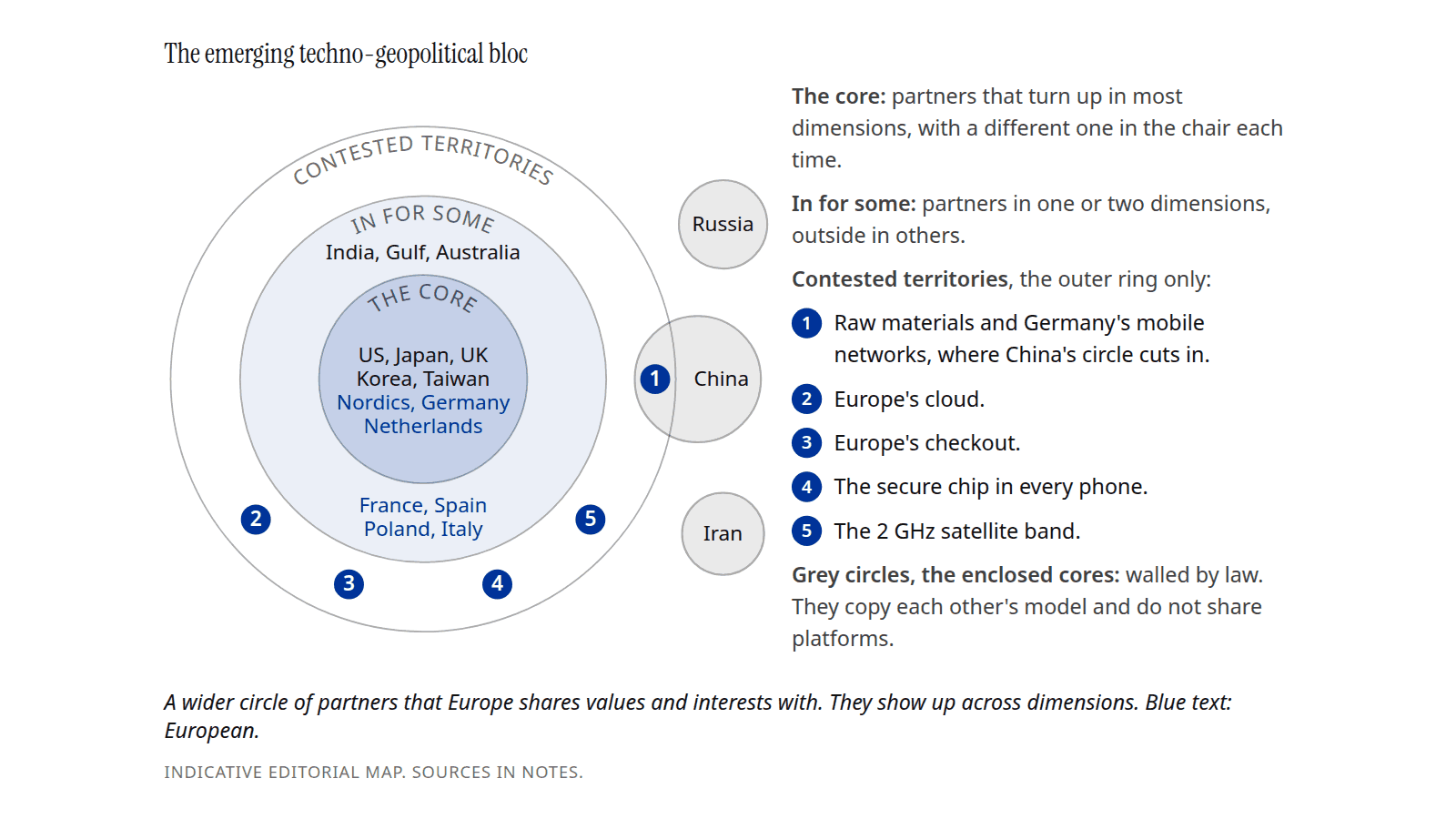
If you ask which side Europe is on in the technology contest, you'll get a Cold-War answer: the EU is with the Western bloc, led by Washington, against Beijing. This summer there was even paper to prove it: on 23 June the European Commission put the Union's name under Pax Silica, the US-led declaration on chips and AI supply chains. That looks familiar. Except that only six of the 27 capitals signed in their own name, twenty-one did not, and the club includes Qatar, India and Kazakhstan, none of them Cold-War allies. And chips are only one layer of technology.
At the next level, the map changes. When it comes to the cloud, Europe is a tenant in somebody else's building. In mobile networks, the United States is Europe's customer. In the field of digital identity, Europe holds a core of its own. Add the layers up and the bloc Europe belongs to is neither the Cold-War West nor the EU. It is a shifting circle whose membership changes with each layer, and Europe's seat changes with it.
In this article, we'll draw seven such maps, ask a question with a European perspective to each, and then find out what they add up to.
Defining the blocs
Most writing on geopolitical blocs starts with countries and asks which camp each one belongs to. We start from the other end. The unit here is the technological dimension: chips, cloud, networks, phone platforms, payments, identity and age checks, chosen for being relevant to current international developments and the concept of European digital sovereignty, our central topic at nupath.eu. For each we ask who holds the core, who has aligned with it, which territory is still fought over, and where Europe fits in. Social media, messaging, office software, search and AI assistants follow in part two.
We divide the blocs into three types, based on the way that they are formed. A declared bloc has a document, signatories and a date; creating or joining it is clearly a political step. An emergent bloc has none of these. Nobody planned it, and yet twenty years of purchasing decisions, market share and equipment already on the ground bind as firmly as a treaty, and when you look back, the pattern is evident. An enclosed bloc is walled by law: a state-backed platform, a mandate to use it, foreign rivals throttled. Russia's state messenger MAX, which its maker says follows the model of China's WeChat, reported 107 million users in March, a few weeks after WhatsApp was blocked in Russia. Enclosed blocs copy each other's model, but don't share platforms.
In traditional geopolitics there is an old saying that "geography is destiny": a country's location, borders, coasts and resources set the limits of what it can do. That is only partly true here. Where the tangible world is concerned, physical geography still rules: minerals in the ground, chip factories on an island, cables on the seabed. Everywhere else, digital technology has a geography of its own. Three parts of it draw most of the maps in this article. Borders: whose law reaches the company that runs a service. Terrain: the equipment already in the ground and the phones already in people's pockets. Straits: the handful of firms nobody can navigate around. The most important difference is that this kind of geography can be redrawn: borders move by law, terrain by procurement, and they do so in years rather than ages. That is also why the emergent blocs follow price, convenience and old contracts, and why their borders ignore the Cold-War map.
Subscribe to continue reading